Saturday, March 28, 2015

Science Poetry: National Geographic Book of Animal Poetry

National Geographic Book of Animal Poetry 


Bibliography 

 Lewis, J. Patrick. National Geographic Book of Animal Poetry: 200 Poems with Photographs That Squeak, Soar, and Roar! Washington, D.C.: National Geographic, 2012.

Review:

National Geographic Book of Animal Poetry is a beautiful collection of photographs and poems that immediately boost the mood of the reader. The reader cannot read this book or even simply look at the pictures without having a renewed appreciation of mother nature and all of her beautiful creatures. The collection opens with a detailed table of contents that divides the book into nine sections ending with a comprehensive list of resources, indexes, and credits.

The range of poetry presented throughout the collection creates a fusion book of poetry and encyclopedia. The information is factual yet sincere and the poetry is playful yet deep. The scope of poetry is not just wide but deep as well. For example, the poem The Saddest Noise by Emily Dickinson is true to the nature of Emily Dickinson poems, in that they are, dreary but still powerful and honest, and the fact that the poem is accompanied by a gorgeous picture of a European Bee-Eater eating a bee gives the poem a new fresh perspective while keeping the integrity of poetry alive. National Geographic Book of Animal Poetry is filled with combinations of poetry and artwork that reveal a different side of poetry and a different side of the animal kingdom.

This anthology of animals and poets speak to readers of all levels and through different voices. Some poems that the perspective of the animal while some speakers reflect on the different species, and some speakers take on the voice of the hunter. The span of voices contributes to the authenticity of poetry within the collection.

The poems also stretch in types of poetry. At points the poems are short haiku's, jolly limericks, and creative free verse; other points the poems explore line length, meter, and word position. Because of this, the book is a perfect resource for all educators in all subject areas. I can picture this book being used in all classrooms at all ages. In a lower elementary classroom the book is a perfect introduction to types of animals and the organization of the animal kingdom; on the other hand, I can see the book being used at the high school level to analyze the impact of word choice and figurative meanings. Finally, National Geographic Book of Animal Poetry is a collection of poetry that is beautifully created and designed to spark a love of   

Spotlight Poem:

The Hippopotamus poem is the first poem in the series I read where I felt a shift in depths of the poems. The poem is from the prospective of hippo hunter which is an interesting lens for the reader because until this poem I felt the poems in the book were written from a protective and appreciative lens. That isn't to say that the speaker does not appreciate the offerings of the hippo; however, the reader is forced to recognize that animals are still viewed as providers for humans. This slightly dimmer view of a poem is what will tingle the hairs of a junior high reader. Therefore, as a teacher-librarian I use this book to transform poetry through perspective and point of view.

The Hippopotamus

I shoot the Hippopotamus
With bullets made of platinum.
Because if I used leaden ones
His hide is sure to flatten'em
- Hilaire Belloc


Follow-up activity:

The comprehensive collection is a great lead into a lesson on perspective. I would read this poem and others in the collection and think about the different perspectives the author uses to convey different meanings. For example, in The Hippopotamus poem the perspective is from the hunter; however, we still learn a fact about hippos. Another example is the Squirrel Forgets in which the perspective of the poem is from the squirrel. The perspectives of these poems help the reader learn various facts about the animals while still giving the reader something interesting to read. After reading these examples, would have the students choose an animal, do some basic research on the animal, choose one fact they found interesting or important to that animal, and create a poem that shares that fact for an interesting perspective.


Sunday, March 1, 2015

All Kinds of Poetry: Verse Novel: Inside Out and Back Again by Thanhha Lai


Inside Out and Back Again by Thanhha Lai 

Bibliography 

Lai, Thanhha. Inside out & Back Again. New York: Harper, 2011.

Review 

Inside Out and Back Again starts shares the story of a Vietnamese family from the perspective of the youngest member Ha. Ha lives in Saigon Vietnam at the height of the Vietnam War, and everything, according to Ha, is moving along swimmingly, until a family friend notifies the family that it is time to evacuate. The family does evacuate Vietnam and takes a treacherous journey by boat to America. While fleeing to America was the safe thing to do for Ha and her family, the family feels completely lost in America. In addition to life adjustments in America, Ha has to adjust to the cruelty of children. At the height of the novel Ha is facing a physical fight with a bully who has been tormenting her since her arrival in the American school. Fortunately for Ha her older, much cooler brother Vu, swoops in saves her on his motorcycle.

Lai tells a timeless story about a girl going through life changes with the backdrop of dramatic events such as the Vietnam War.   Lai tells this story through verse novel organized into four parts over the time period of one year. Because the voices is that of a ten-year-old girl the poetry doesn't not have strict rhyme schemes, or elaborate metaphors, but it does experiment with line length, and imagery. For example Ha writes, "Uncle Son flares elbows into wings,/ lunges foward/protecting his children." Lai fills the pages with these simple yet powerful descriptions that make the novel a pleasure to read.

Spotlight

Rainbow takes place in part three of the novel just after the family is starting American schools and getting acquainted with life in America. The poem is a reflection of Ha's description of her new, different looking classmates.

Rainbow

I face the class.
MiSSS SScott speaks.
Each classmate says something.

I don't understand,
but I see.

Fire hair on skin dotted with spots.
Fuzzy dark hair on skin shiny as lacquer.
Hair the color of root on milky skin.
Lots of braids on milk chocolate.
White hair on pink boy.
Honey hair with orange ribbons on see-through skin.
Hair with barrettes in all colors on bronze bread.

I'm the only
straight black
on olive skin.

Follow-up Activity 

I love this poem because it describes most people in the class without saying "she has brown hair" or "she has red hair" it challenges the reader to make these pictures in their minds, but also done so artfully. I would use this poem to teach show not tell. Show not tell is a classic lesson in writing class where you encourage children to look a picture and describe what is there without simply naming the item. I would challenge the students to write a poem based on their classmates without using their classmates names or labeling them "kid in third row". These would make for great getting to know you poems to display at the beginning of the school year. 

All Kinds of Poetry: Poetic Form: Zombie Haiku by Ryan Mecum


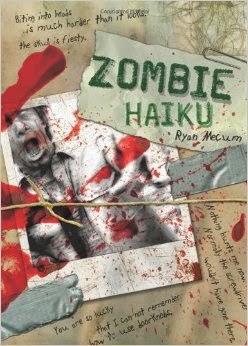
Zombie Haiku by Ryan Mecum 


Bibliography

Mecum, Ryan. Zombie Haiku. Cincinnati, Ohio: HOW Books, 2008.

Review

Zombie Haiku mashes together two unlikely forms, gore and haiku. The verse novel starts with the journal writings of the new owner of the journal Chris Lynch. Lynch is running from the zombies that have taken over the world in the back drop of an airport. Lynch finds this journal that contains the haiku's of another owner. At the beginning of the haiku journal, the original owner is capturing the beauty of the world right before the zombie takeover. As haiku's progress, we learn that we are really reading the novels of a newly bitten human, and we read their transformation into a zombie. The poems are little expressions of the inner thoughts and feelings of a zombie as it is making its way through this new and violent life.

Mecum creates this eerie voice of a zombie through word choice, punctuation, font, images, and structure. Firstly, words and lines such as "With his jaw snapped off/ he can't bite into people..." this line is shockingly grotesque, but some how doesn't cross the line into inappropriate. It is these lines that keep the reader intrigued with one hand over their mouth, and reading out of the side of their left eye. Secondly, the punctuation ranges from uses of commas, hyphens, and colons. The punctuation adds to the rhythm of the poems and guide the reader through the poems seamlessly. The use of quotation marks brings in the voices of other humans and adds to the intensity of the novel; for example, "When there's no more room in Hell..." As the reader you then place yourself in the place of that human and experience the emotions of the human. In addition to punctuation, the font types and graphic images give the novel a feeling of authenticity. The handwriting font ranges from big to small to spread out to smashed together, and this detail creates the ominous mood. Finally, the structure of the haiku novel creates a movie in you mind. Opening with journal entries, and moving the character from human to zombie and then back again with the second character creates a truly unique collection of poetry.

Spotlight

The turning point of the novel when the main voice is bitten by zombie and he is making the transformation from human to zombie is an intense process and a teaching point in voice. The voice moves from one of scared and running to acceptance and empty.

My skin is drying.
my veins are much more pronounced
and I'm turning gray.

The diseased outside
slowly stop clawing the car,
uninterested.

My lungs slow and stop.
and I can't find my heartbeat.
but I'm still hungry.


Follow-up Activity

I would use this collection of poems to demonstrate that poems can express the emotions of all sorts of living and none living things. I would as the students to chose something that goes from living to dead and speak the point of view of that thing. Whether it be fantasy creatures, plants, or animals I want the students to speak the voice of the typically unspoken, and tell the story of something that isn't typically heard.

All Kinds of Poetry: New Poetry: Hope is a Ferris Wheel by Robin Herrera


Hope is a Ferris Wheel by Robin Herrera

Bibliography 

Herrera, Robin. Hope Is a Ferris Wheel. New York City, New York: Amulet Books and Amulet Paperbacks, 2014.

Review

Hope is a Ferris Wheel is the story of a girl (Star Mackie), Emily Dickinson, and finding hope in the hopeless. After moving to a trailer park in California, Star, a ten-year-old girl, makes it her mission to start the most successful club her school has ever seen. After a rough start with the self titled "trailer park club," the innocent Star regroups and creates the "Emily Dickenson Club". From the inspiration of her boring and lame homeroom teacher Mr. Savage, Star finds a deep connection to the Emily Dickenson poem "Hope is a Thing with Feathers," and thus starts her journey to loving poetry.

Robin Herrera, the young, up and coming author, masterfully weaves together a poetic novel. Through a combination of list poetry, prose poems, and haiku's sprinkled throughout, Herrera builds a unique piece of literature. The list poetry comes in the form of vocabulary homework. Mr. Savage, Star's lame and boring teacher, assigns the class vocabulary words weekly. These vocabulary assignments, or list poetry, become an insight into Star's inner conflicts. Herrera uses the vocabulary list to help the reader understand the inner struggles both superficial and serious that Star navigates through. The prose poetry, true to its definition, comes in the form of paragraphs. The paragraphs
lead the reader through the novel focusing on Star's feelings, thoughts, fears, dreams, and most importantly her hope for the future. Lastly, Herrera comically uses haiku's to demonstrate the clubs attempts at poetry. These poems offer a comedic relief for the reader.

The hallmark of Hope is a Ferris Wheel is the honest, innocent, and strong voice of Star Mackie. If I did not know any better, I would assume a ten-year-old wrote the novel. The voice is true to the thoughts, actions, and feelings of a ten-year-old that the reader finds themselves in their own ten-year-old brain. Herrera's word choice for Star creates a girl who is observant about life and truly wants to seek a larger purpose. Star is the perfect balance of blind hope and realistic dreaming, and it is through word choice, voice, and structure that this beautiful character and novel is created.

Spotlight

Hope is a ferris wheel-
It takes you Low and High
And when you reach the Top.
It's like you can touch The Sky!
And when it takes you Down-
Hope becomes A Thing
That, When you're getting Off,
You take With you to Bring.

- By Star Mackie

The entire novel is written around Star writing this poem. It takes several attempts and quite a few life experiences to complete this poem. The poem is a clear mimic of Emily Dickenson's Hope is a Thing with Feathers, but it is written to express Star's recent realizations about life, hope, and the future.

Follow-up Activity 

A subplot of this story is the author study that Star and her friends experience in the Emily Dickenson Club. As a follow-up activity, I would ask my students to choose an author of poetry that they would like to study. I would have the students research and evaluate the poet, then create a book or small collection of unique poems that share the qualities of that author.

Monday, February 16, 2015

Major Poets and Awards: NCTE Award Winning Poet- Nikki Grimes


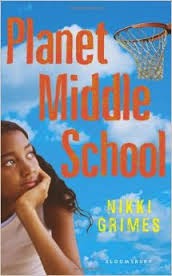
Planet Middle School by Nikki Grimes


Bibliography 

Grimes, Nikki. 2011. Planet Middle School. New York: Bloomsbury Childrens.
ISBN: 978-1-59990-284-5

Review

Planet Middle School opens with a poem that doesn't tie together until the reader reaches the last few poems of the verse novel. Throughout the novel the reader is anticipating the meaning of that first poem. Nikki Grimes, well-known for her authenticity of voice, creates the character Joylin. Joy is a middle school age African-American girl who spends the novel trying to navigate the often confusing time of a middle school girl. Grimes touches on the topics of family dynamics, body acceptance, and friendships. Throughout the novel, Grimes uses different poetic forms ranging from free verse to haiku. The poetic variety gives the novel a natural rhythm that keeps the reader flipping pages. Planet Middle School is perfect for a young girl who is on the brink of understanding the complications life has too offer. Grimes takes these classic young adult themes and gives them a voice all girls can relate too.

Grimes transforms these heavy-hitting themes into authentic poems about what a young girl struggles with early on in life. Grimes uses a figurative language, word choice, and emotional impact to create these concise yet spirited poems. For example, in the poem titled "Beginnings" Grimes introduces Joylin's best friend by describing how they met and their common interest basketball; furthermore, Grimes writes the line  "Jake doesn't talk much,/but the silences between us/are filled with friendship," the reader can immediately identify the feeling of true friendship between the characters. All readers have that friend that silence can be felt and enjoyed without feeling the pressures to talk, and Grimes strings together those words to perfect describe everyone's best friend.

In addition, she uses language like "'That's nice,' Dad whispers/ and turns away,/ letting all the air/ out of Caden's balloon/ and mine," to personify the feelings of disappointment children can feel from their parents. Another example of Grimes honing in on that relevant, authentic voice. Planet Middle School is a collection of poems that help guide the feelings of a young girl to a path of reflection and understanding of lives different milestones. 


Spotlight

One of the most unique poems titled Tom Boy questions this idea of what it means to be a girl when the girl doesn't identify with heteronormativities. The poem is filled with question marks that immediately speak to this idea of girls questioning what is forced upon them, a message often preached but not supported in the classroom.


Tom Boy

What does that
even mean?
And where did it come from?
And if there's a Tom Boy,
how come there's no Jane Girl?
I'm just sayin'.


Follow-up Activity

I would save this poem for my club of all girls. I would have the students corral read this poem to give it a sense of unity and understanding of the differences that exist within a group of girls. I would have the girls identify qualities that they consider to be unacceptable about a girl. I would have them identify a time they judged a girl they didn't know and why they made these judgments. After sharing these stories, I would have the girls think of a negative name they have been called and question its meaning to them and its impact on others when they use this name. Then I would have them create a poem that reflects their feels and emotions about the negative name, mimicking its punctuation and line length techniques. 


Sunday, February 15, 2015

Major Poets and Awards: Florian: Poetrees by Douglas Florian

Poetrees by Douglas Florian   


Bibliography

Florian, Douglas. 2010. Poetrees. New York: Beach Lane Books.
ISBN:978-1-4169-8672-0

Review

Poetrees is a clever, informative, artistic book of poems about the diverse beauty of the life of a tree. Douglas Florian is an artist with both the brush and the tongue. Florian's book opens vertically creating an elongated treelike effect on the reader. Each page has a painting that is a visual representation of the poems meaning or topic. For example, on page one the first poem is appropriately titled "The Seed." The poem is short and the words are arranged in the shape of an infinity symbol to represent the cyclic nature of a trees and growth; in addition, there is an enlarged painting beneath the poem of the inside of a seed. The painting says as much as the poem itself. 

As the book progresses Florian dapples in different rhyme schemes and eloquently tinkers with different forms of poetry. On page 19 Florian uses the entire page to create a majestic piece of poetry about a Giant Sequoias. The poem takes on the AABB rhyme scheme; the line lengths range from two words to three words to four words per line that adds to the overall rhythm of the poem; finally a piece of art accompanies the poem transforming the words into a visual for the reader. For this particular poem Florain uses a combination of paint and clip art to create a Giant Sequoia. 

The word play throughout the book keeps a new reader laughing, smiling, and asking for more. As I read this particular book to a four year old he found the onamonapias and double meaning words in the "Bark" poem to be hilarious and wanted me to reread the poem as many times as I was going to allow. It was in his reaction that it became clear that this book is the perfect book to introduce the silly side of poetry. 

Keeping with the informative nature of Florian poetry books, the book caps off with a glossary of terms and trees used in the book. Because of this feature, I would utilize this book in an elementary science class before introducing the unit on tree cycles. 

Spotlight

The poem "Leaves" is a simple fun poem that ends with another perfect example of multiple meaning words. The poems simple descriptions of leaves makes the content reachable for new readers, but the word choice is still strong and rich.

Leaves

Lobed Leaves.
Oval Leaves.
Smooth leaves or jagged.
Heart-shaped.
Odd-Shaped.
Leaves eaten ragged.
Fan-like.
Light leaves.
Dark.
Leathery.
Feathery.
Leaves in a park.
Two points.
Ten points.
Points like a saw.
Lovely leaves.
Leave me in awe.

Follow-Up Lesson 


As I previously mentioned, I would use this book to introduce a science unit on the tree cycle and genetic variety because it generalizes the life of a tree and hints at the idea of genetic variety. I would model this poem after an investigation on leaves. I would have the young students collect and observe different leaves making sure they listed their different characteristics. Then I would read them "Leaves" and have them recreate the list form poem using the different descriptions they came up with in their observations. Having the students realize that science and reading can overlap in a meaningful way is a lesson that can make abstract poetry into something as concrete as science.


Major Poets and Awards: Multicultural Poetry- Dizzy in Your Eyes by Pat Mora

Dizzy in Your Eyes by Pat Mora


Bibliography 

Mora, Pat. 2010. Dizzy In Your Eyes. New York: Alfred A. Knopf.

ISBN: 978-0-375-94565-6

Review

Dizzy in Your Eyes opens with an informative yet sincere letter to the reader. The letter explains that the book begins with free verse style and then progresses to stylistic forms such as haiku, sonnets, and clerihew. The letter continues with an example of a clerihew titled Pat Mora. To keep with the nature of the poems form, Mora's clerihew pokes gentle fun at herself as a poet. Following the delightfully explanatory letter, comes a book of poems that reach every emotion love has to offer.

As promised, Mora begins the book with a free verse poem titled "Weird" the poem, like other poems in the collection, Weird captures this minute feeling a person has as they attempt to reach out to another person of interest for the first time. Continuing, Mora writes poems that find these indiscernible feelings a person has as they are exploring the different angles of love in life, and she flawlessly strings words together to personify those emotions.

The poems are published on only the odd numbered pages with abstract graphic art on the even number pages. The upshot from publishing the poems on odd number pages is the flow that is created for the reader. As the reader finishes one poem the flow to the next is seamless and effortless. There is a sense of desire to see what emotion Mora is going to explore next. Another repercussion of printing the poems on odd pages is the helpful definition of the poetic form that is sporadically printed on the even numbered pages. Just as Mora mentioned in the letter to the reader she explores different poetic forms throughout the novel, and on the even numbered pages she defines the poetic form and indicates its usage in other poems throughout the book.

One of the most unique qualities to Mora's poems is the fact that the speakers of each poem changes from poem to poem. The reader is never really sure if the speaker is a boy, a girl, an older speakers, or a younger speaker. The poems are also just as wide as they are deep. They expand from the idea of "boyfriend" "girlfriend" love to sisterly love, to blended family, and split family love. However, the poems are open to personal interpretation. For example, the poem titled "Back Then" captivates the feeling someone has as they are remembering the feeling of excitement. The line "...and I'd feel like I'd swallowed a slice of sun" is written in past tense and allows the reader to interpret that as either a loss of the feeling or as a simple remembrance of person and the feeling they evoked for the speaker. Mora recreates this idea of personal interpretation throughout the collection which makes Dizzy in Your Eyes a collection that can be read over and over again.

As a side note: I got this book from the Euless Public Library and as I was reading I found that three poems were torn out of the novel. I think this fact alone proves that the poems speak to its readers and even motivates them to keep the poem for themselves. 


Spotlight 

The poem titled "Broken Home?" is a tanka poem that Mora notes is purposefully divided into two sections to show the passage of time. The first half of the poem highlights the traumatic experience children often experience as their parents make a decision to be co-parents and to not remain husband and wife. The word choice in part one reflects the voice of a young child trying to navigate the idea of what it means to be from a broken home. In part two the word choice reflects a young adult who understands that labels are for onlookers not for participants.  

Broken Home?

I

Long, sad, first weekend, 
my strange room: a cold, white box.
My brother pouts, cries.
Another first: Dad cooking. 
Is our home really broken?

II

Two houses, one home. 
Birthdays pull us together.
Singing heals our hurts.
Us four, always family, 
a home we make for ourselves. 

Follow-up lesson 


For this poem a follow-up lesson would be a more serious lesson for students and children that revolves around the theme just because an aspect of your life isn't considered "ideal" doesn't mean your life does have value or purpose. I would have the students identify something about themselves that they would consider atypical including: divorced parents, a blended family, an LGBT family unit, also including personal irregularity such as: attention deficient disorder, dyslexia, dysgraphia, too tall, or too short, anything the student feels makes them different, Then I would have them plot out a tanka poem of their own that captures their feelings about their difference.